Why You Should Automate Your Excel Spreadsheet with VBA Macros

Kids Build Rocket

Look What I Did

Spoiler Alert: I shamelessly self-promote our services here at ProsperSpark in Omaha, Nebraska.

You just built a sweet Excel spreadsheet.

It does everything your boss wants it to do. It tracks all of those pesky [insert your company's key data points here].

It looks good.

It looks really good.

I mean, you even used the company's logo, color scheme, and everything.

There's just one problem. It's super hard to update.

There are 100+ columns. It takes a while to enter a new row for each contract, sale, piece of equipment, service performed, or whatever else your company tracks religiously.

All that scrolling left and right to enter one row of data... it's just too much.

Knowing the Possibilities

Half the battle is typically knowing what can be accomplished, not how.

Do you think Steve Jobs knew how he was going to create a brand new industry when the iPhone idea was pitched to him?

I highly doubt it.

What he did know was that touchscreen technology existed. He knew that mobile internet access was possible. He also knew that he had an army of software engineers at his disposal.

The point here is this; know what's possible and then worry about how to execute. The same goes for your Excel spreadsheet or automation (VBA macros) project.

Keep this in mind; anything you do in Excel can be automated for the most part. Here's a short list of examples of what you can automate within Microsoft Office.

  • Cleaning up an export file; rearranging columns, deleting rows/columns, etc.
  • Importing data. This includes opening a file, copying data, pasting into a different file/tab, and then closing the original file.
  • Clearing a form.
  • Parsing data. Maybe you get a report where all of the names/addresses are in one cell. This can be automatically separated into multiple columns.
  • Extracting data from an automated email you receive. (Yes, even in Outlook.)
  • Updating data, text, and/or charts in a PowerPoint presentation right from Excel.
  • Scraping data from the internet and inputting into an Excel database.
  • Sending weekly individual reports (like commission statements, performance reports, managerial KPI's, etc.) out in a matter of a few seconds.

Bottom line, you may have graduated in 1999, but your spreadsheets don't have to look and operate like they are.
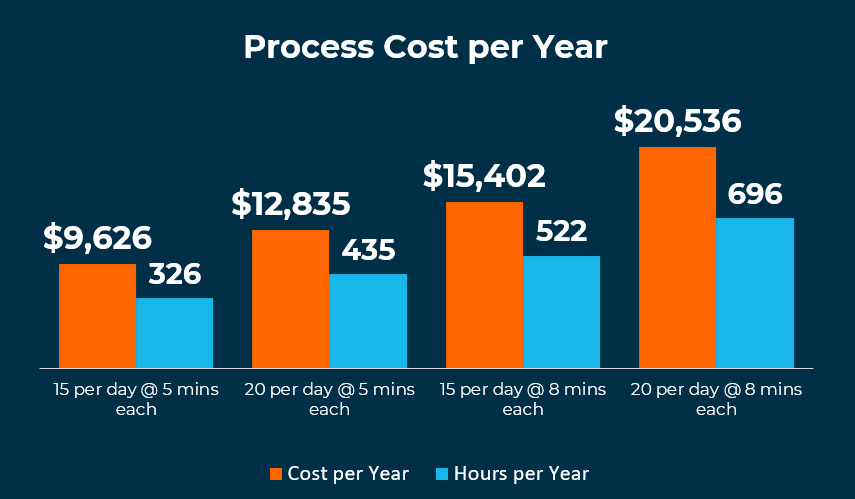
Process Cost Per Year

The Numbers

You have got a great idea. It takes about 5-8 minutes to add a new row because you have to continually reference different fields in the database and other information from the client email.

You are going to automate the input. You've seen a few videos where somebody creates a form in Excel to update a database.

The company has grown quite a bit in the last year or two. You know that you will need to have better record keeping so you can leverage that data to win more future business. You know that in today's age, companies don't survive if they don't employ data analytics.

Someone will be entering 15-20 entries every day. The hope is that the number of entries rises because if it does, that means the business is growing.

You start doing the math.

That means that in this example, the cost ranges from $9,620 to $20,536 depending on how many entries per day (15-20) and how long it takes (5-8 minutes)

The Math (Click Here to See Calculations)

There are 261 working days in a year. That means between 3,915 - 5,220 entries per year. Take that times 5 minutes per entry, and you get 326 - 435 hours in a year. That's 8 to 11 full 40-hour workweeks.

At 8 minutes a piece, it comes out to 522 to 696 hours annually or 13 to 17+ workweeks.

The median household income according to an article on CNBC online, in 2018 was $61,372. That means that based on 2,080 working hours per year, the average rate per hour is $29.51. Take this hourly rate and multiply it times the annual hourly estimates provided above to get the annual cost estimates.

Yowser.

Sally, the sales administrative assistant, can get faster over time and she will probably be able to multi-task while she's doing it.

Sure.

That's probably a fair expectation. However, how much of an impact will that truly make? Ten percent? Twenty percent? Fifty percent?

You wouldn't bet anything above twenty percent.

The Task

For the sake of example, let's say you are attempting to generate sales quotes and record the deal details in Excel.

Looking at the data, you know that more often than not the company is quoting the same configurations over and over again.

That's when you have a great idea.

Why don't we have a few buttons that pre-populate specific deal configurations for the quote in Excel? Well, if that's possible, why can't we have that same data be recorded in a database for data analytic purposes?

You can.

You can also have a button that exports your quote to a PDF with a dynamic name, saves it to a specified folder, and attaches it to a customized email. During this process, your sales database is updated with that quote with all of the pertinent details; quote number, sales rep, cost, price, margin, configuration, etc.

This all happens in a few seconds.

There's just one problem. You have no idea how to do this.

Using Your Resources

That's when you call Jim.

Yep, that Jim.

He's the guy that you know is going to scold you for building it the wrong way. Now, he may not outright tell you that... but he lets you know.

Jim is the company’s de facto “spreadsheet guy.” Every company has a “Jim.” He is the guy that does all of that advanced Excel stuff throughout the company. 

There's just one problem.

Jim has a real job. He is also the [insert Jim’s title here]. He's got a full plate of work already, and it's going to be several weeks or a few months before he can even look at a project that doesn't help reduce his workload.

Saving Time & Making Life Easier

Now that you have an idea of what you can automate, it's time for action.

Don't be the one who settles for "it will be fine" or "we will figure it out."

Expect more.

Nothing says you have to hire us here at ProsperSpark. Heck, nothing says you have to hire an outside firm or consultant. However, if you read my last article on this topic, you already know it's in your best interest to do so.

You're a good recruiter, plumber, electrician, therapist, insurance firm, mechanic, dentist, lawyer, [insert your profession here.] Either way, you know Excel spreadsheets are not your forte.

What you do know, is that spending $9,620 to $20,538 per year is crazy talk. Cutting that in at least half is more than doable and necessary.

This is why successful businesses, possibly your competitors, are automating processes where they can.

Stagnant processes cost you time and money.

That's why automating processes should be a priority for your business.

Solution

You decided “it will be fine” was not fine.

You took action.

You picked up the phone and called ProsperSpark (okay, hopefully, you called us).

The solution was rather straight-forward. Instead of one large database, there was a simple button that the user clicks to pop up a form. The form is user-friendly with preset options for the sales configurations you typically present to your customers. All of the pertinent deal details were all visible on the screen in an organized fashion.

No more scrolling left and right.

Click a button to save it, and it adds the deal details to a database. It then automatically updates your new sales dashboard (yep, ProsperSpark creates these too).

To send it to the client, all you have to do is click a button, and the quote is exported to PDF. It is then saved to your shared drive, named appropriately with the client’s name, and attached to an email with the client’s email already populated.

All you have to do is hit send. It took just a few seconds to generate the PDF and email.

In the end, you cut your data entry time in about half; from 5-8 minutes to 2-4 minutes. Additionally, the entire PDF quotation generation time is now about a fourth of what it was before

You have a whole lot more time. What do you do with this new found time?

Whatever you want!

Maybe it’s more sales calls, more time for projects, or more time with your friends and family.

The bottom line is that more time allows you to improve your business and life.

Google “VBA macro consulting [insert your city name here].” Find a reputable consultant and reach out to them.

Stop accepting tedious and time-consuming tasks as “it’s just the way it is” and let someone help you.

Written by

  • Brandon Zobel is the CEO and founder of ProsperSpark, where he helps businesses improve operations through smarter systems, automation, and custom-built solutions. With a long-standing passion for technology and process improvement, Brandon has worked with companies across industries to reduce manual work, streamline workflows, and solve complex business challenges using tools like Excel, Airtable, low-code platforms, and cloud-based systems. He started ProsperSpark to give businesses a practical partner for building solutions that fit the way they actually work. Brandon helps shape ProsperSpark’s educational content to make sure it stays grounded in real-world experience, real operational pain points, and solutions that deliver measurable results.

Automation in Excel means using Excel's built-in tools and programming capabilities to handle repetitive tasks automatically, without someone doing the same steps manually every time. That can range from a simple macro that formats a report in one click to a VBA script that pulls data from multiple sources, runs calculations, and emails a finished file to your team every Monday morning.

Most business users know Excel can do more than what they are using it for. The gap is usually not awareness that automation exists. It is clarity on what it actually covers, what it takes to build it, and whether their situation calls for it. This post covers all three.

What Does Automation in Excel Actually Mean?

Excel automation is a broad term. It gets used to describe anything from recording a simple keyboard shortcut to building a fully connected reporting system that syncs with your CRM. Both are real uses of Excel automation. They are just at very different ends of the spectrum.

At its core, Excel automation means reducing or eliminating manual steps inside a workflow that already lives in Excel. The automation handles the repetitive logic so people can focus on the work that actually requires judgment.

The most common forms:

    • Macros that record and replay a sequence of actions
    • VBA code that adds custom logic, conditions, and control over what Excel does
    • Power Query that pulls, cleans, and reshapes data from external sources automatically
    • Formulas and dynamic arrays that update results without manual recalculation
    • Connections to external systems via API so data flows into Excel without re-entry

The Four Main Tools for Excel Automation


1. Macros

A macro is a recorded set of actions. You perform a task once while Excel records it, and then you can replay that sequence any time with a single click or keyboard shortcut. Macros are a good starting point for repetitive formatting, filtering, or report generation tasks that follow the same steps every time.

The limitation is that recorded macros are rigid. They replay exactly what was recorded, which means they can break when the data changes shape. For anything more flexible or conditional, you need VBA. See our guide on how to use a macro in Excel for a walkthrough of the basics.

2. VBA (Visual Basic for Applications)

VBA is the programming language built into Excel. It is what gives macros their logic. With VBA, you can write automation that responds to conditions, loops through data, checks for errors, sends emails, generates files, interacts with other Office applications, and connects to external systems.

Most serious Excel automation involves VBA. It is the layer that makes the difference between a spreadsheet that does one thing and a tool that handles a full workflow. You do not need to be a developer to understand what VBA can do, but building it well requires real skill and testing.

3. Power Query

Power Query is Excel's built-in data transformation engine. It connects to databases, CSV files, SharePoint lists, web pages, and other data sources, then pulls that data into Excel in a structured, repeatable way. Once you build a Power Query connection, refreshing the data takes a single click.

For teams that spend time every week downloading exports, copying data between files, or cleaning up inconsistent formats before they can do any analysis, Power Query often delivers the most immediate time savings of any Excel automation tool.

4. API Connections and External Integrations

Excel can connect to external platforms via API, pulling live data from systems like Salesforce, HubSpot, or custom databases directly into your spreadsheet. This approach is more technical than macros or Power Query, but it eliminates the manual export-and-import cycle that creates data lag and version risk in most reporting workflows.

When Excel is your reporting or modeling layer but the data lives somewhere else, API connections are what close the gap. Our Excel and VBA consulting team handles these integrations as part of broader build engagements.

What Business Problems Does Excel Automation Actually Solve?

The value of Excel automation is not the automation itself. It is the business problem it removes. Here are the most common situations where it makes a real difference:


    • Weekly reports that require manual assembly. If someone pulls data from two or three sources, formats it, checks it, and sends it every week, that is a strong automation candidate. VBA or Power Query can handle the pull, format, and output automatically.
    • Data that gets re-entered across multiple files. When the same information lives in multiple places because someone copied it there, that creates version risk and wasted time. Automation consolidates the source and eliminates the copy-paste cycle.
    • Calculations that must run the same way every time. Commission calculations, pricing models, inventory adjustments. When the logic is fixed and the stakes are high, automating it removes human error from the equation.
    • Output that needs to be formatted consistently. Client-facing reports, proposals, invoices. Automation handles the formatting so the output looks the same regardless of who runs it.
    • Repetitive data cleaning. If someone spends time every week removing duplicates, fixing date formats, or standardizing field values before they can do anything useful with the data, Power Query can handle most of that automatically.

How to Approach an Excel Automation Project: 5 Steps


    1. Define the manual process clearly. Before anything gets built, write out every step someone does today. Where does the data come from? What happens to it? What does the output need to look like? Automation built on a fuzzy process description usually requires rework.
    2. Identify what is repetitive vs. what requires judgment. Automation handles the predictable steps. If part of the workflow requires someone to make a call based on context or exceptions, that step likely stays manual. Be clear about the boundary.
    3. Start with the highest-pain step. You do not have to automate the entire workflow at once. The step that takes the most time, creates the most errors, or blocks the rest of the process is usually the right place to start.
    4. Build in validation and error handling. Good Excel automation does not just run. It checks that inputs are in the expected format, flags anomalies, and fails gracefully when something unexpected happens. Skipping this step is where a lot of home-built automation becomes unreliable.
    5. Document what was built and who owns it. An undocumented automation is a liability. When the person who built it leaves or the data structure changes, nobody knows how it works or what to fix. Documentation is part of the deliverable, not optional.

How Much Time Can Excel Automation Actually Save?

The honest answer is that it depends heavily on the task and how often it runs. That said, here are directional ranges based on patterns we see in real projects:

    • A weekly report that takes 2 to 3 hours to assemble manually often gets reduced to 10 to 15 minutes with automation, or fully hands-off if the output is scheduled.
    • Data cleaning tasks that run daily can go from 30 to 60 minutes to near-zero. Power Query handles the transformation on refresh.
    • Commission or pricing calculations that require someone to pull numbers, run formulas, and check outputs manually can be consolidated into a single-click process, typically cutting the time by 70 to 90 percent.

These are estimates, not guarantees. The actual savings depend on the complexity of the current process, how clean the data is, and how much exception handling is required. Our post on outsourcing Excel work has more on how to think about the cost-benefit side.

Common Mistakes in Excel Automation

    • Automating a broken process. If the manual workflow is inconsistent or poorly defined, automation will just make the inconsistency run faster. Clean up the process first.
    • Building without error handling. Automation that fails silently is worse than no automation. When something goes wrong and nobody knows it, the output gets trusted even when it should not be.
    • No named owner after go-live. Excel automation needs someone responsible for maintaining it when data structures change, source files move, or the business process evolves. Without an owner, it quietly breaks.
    • Over-relying on recorded macros for complex logic. Recorded macros are brittle. They work until the data looks slightly different. For anything that needs to handle variability, VBA is the right tool.
    • Treating Excel as a database for multi-user workflows. Excel automation works best when one person or a controlled process is writing to the file. When multiple people are editing simultaneously, you get version conflicts and automation that fights itself.


When to Get Outside Help with Excel Automation

Some Excel automation is straightforward enough to handle in-house, especially if someone on the team already knows Power Query or basic VBA. Other situations are worth bringing in outside help:

    • The workflow connects to external systems, APIs, or databases
    • The file is business-critical and errors have real financial or operational consequences
    • Multiple people depend on the output and reliability matters
    • The existing file is fragile and nobody is confident touching it
    • VBA is required but nobody on the team has the time or experience to build it properly

Our guide on how to find and hire an Excel consultant covers how to evaluate your options and what to look for. For teams that have a larger body of Excel work, on-demand consulting sessions are another option for tackling specific problems without a full project engagement.

Frequently Asked Questions

What is automation in Excel?

Automation in Excel means using tools like macros, VBA, Power Query, and API connections to handle repetitive tasks automatically. Instead of someone manually pulling data, formatting files, and running calculations each time, the automation does it consistently and on demand. The scope can range from a simple one-click macro to a fully connected reporting system.

What is a macro in Excel and how is it different from VBA?

A macro is a recorded sequence of actions that Excel can replay. VBA is the programming language that powers those macros and adds logic, conditions, and flexibility. A recorded macro does the same thing every time. VBA lets you write automation that responds to different inputs, handles exceptions, and performs more complex operations. Most serious Excel automation uses VBA rather than recorded macros alone.

What are the best Excel automation tools?

The most widely used tools for automation in Excel are macros and VBA, Power Query for data connections and transformation, dynamic arrays and advanced formulas for real-time calculation, and API integrations for pulling live data from external systems. For teams that need automation to cross application boundaries, tools like Power Automate can connect Excel to other platforms in the Microsoft ecosystem.

When does Excel automation make sense vs. switching to a different system?

Excel automation makes sense when the workflow is Excel-based, the team already knows the tool, the process is well-defined, and the complexity of the automation is within what Excel handles reliably. When permission requirements get complex, when multiple departments need to edit the same records simultaneously, or when the volume of data grows past what Excel manages cleanly, it may be time to evaluate other platforms. Our post on no-code vs. custom software (prosperspark.com/airtable-make-zapier-or-custom-software) covers that decision in more detail.

How long does it take to build Excel automation?

It depends on the complexity. A macro for a simple formatting task can be built in an hour. A VBA-based reporting system that pulls from multiple sources, runs logic, and generates formatted outputs might take several days. The cleaner the process definition going in, the faster the build tends to go. Most projects benefit from a scoping conversation before any work starts.

What are the biggest risks with Excel automation?

The main risks are automation that fails silently, automation built on poorly documented logic that nobody can maintain, and automation that breaks when the underlying data structure changes. All three are manageable with proper error handling, documentation, and a named owner. The $6 billion Excel error (prosperspark.com/the-6-billion-excel-error) is the extreme example of what happens when critical logic lives in a spreadsheet nobody fully controls.

Can Excel automation connect to other business systems?

Yes. Excel can pull data from databases, APIs, SharePoint, web pages, and other Microsoft applications via Power Query or VBA-based connections. How cleanly this works depends on the source system and how the connection is structured. For workflows that need live data from a CRM or ERP, API connections are usually the more reliable path compared to scheduled exports.

What skills does an Excel automation consultant need?

Strong Excel automation consulting requires VBA proficiency, Power Query experience, an understanding of how data flows between systems, and the ability to build in validation and error handling. Communication matters too. The best consultants spend time understanding the actual business process before writing any code. Our post on Excel consultant skills covers what to look for in more detail.

The Bottom Line

Automation in Excel can remove significant manual work from reporting, data processing, and calculation-heavy workflows. The key is being clear about what you are automating and why. Start with the step that creates the most pain, build in validation, and make sure someone owns the result.

ProsperSpark builds custom Excel automation for business teams across finance, operations, HR, and sales. If you have a process that is taking too many manual hours to run, we can help you scope what it would take to automate it.

Get On-Demand Support!

Solve your problem today with an Excel or VBA expert!

Follow Us

Focused business analysis with charts and graphs on a laptop in a modern office setting.

How to Find and Hire an Excel Consultant

Finding the right person to hire as an Excel consultant comes down to knowing what the work actually requires. Not all Excel work is the same. A consultant who builds financial models may not be the right fit for someone who needs VBA automation or a reporting...

How to Prevent Spreadsheets from Causing Financial Errors

How to Prevent Spreadsheets from Causing Financial Errors

Spreadsheets do not usually fail because Excel is “bad.” They fail because important financial work ends up living inside files that were never designed to carry that much risk. That is when small issues turn into expensive ones. Most issues show up the same way:...

Top-down view of a white desk with a laptop, coffee cup, plant, glasses, pen, and notebook, featuring the Excel, Google Sheets, and Airtable logos in the center.

Excel vs Google Sheets vs Airtable for Ops Teams

For most ops teams, the cleanest setup is Excel for analysis and Airtable for workflow tracking. Excel is stronger for modeling, reporting, and controlled templates. Airtable is stronger when the “tracker” is really a system with owners, statuses, and handoffs. Google...

Pin It on Pinterest

Share This